
In the corrugated board and converting industry, a strapping machine is an automated or semi‑automated unit that applies a plastic (PP/PET) or steel strap around bundles, stacks, or pallets of corrugated sheets, boxes, or finished packaging.
Its purpose is to secure products for handling, storage, and transport — keeping them aligned, preventing damage, and ensuring they arrive in perfect condition.
In high‑speed converting lines (e.g., after a flexo folder gluer or casemaker), strapping machines are often inline to bundle stacks automatically without slowing production.
Common Types
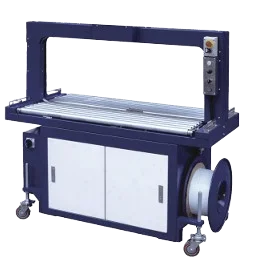
Semi Automatic Table Top Strappers
Operator fed; for low volume bundling.
Fully Automatic Inline Strappers
Integrated into production lines; no operator needed.
Cross Strapping Machines
Apply straps in two perpendicular directions for extra stability.
Pallet Strapping Systems
For securing palletized loads of corrugated board.
Side Seal Strappers
Sealing head mounted on the side for dusty or debris prone environments.
Top Seal Strappers
Sealing head on top; common for pallet loads
Combination Strapping & Banding Units
For delicate or printed surfaces, combining strap with paper/plastic banding.
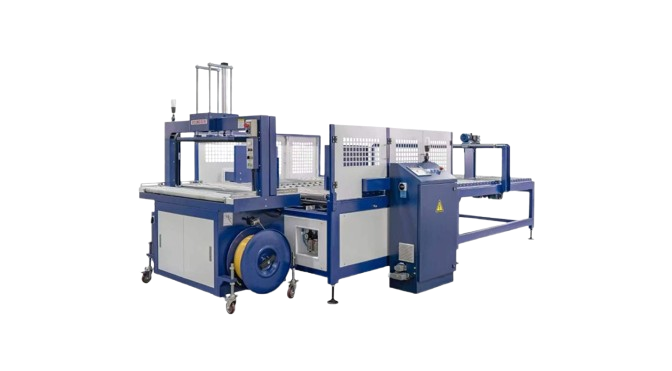
Construction Features
A modern corrugated strapping machine typically includes:- Frame & Conveyor System – Guides and transports bundles into the strapping zone.
- Strap Feeding & Tensioning Unit – Feeds strap around the load, applies adjustable tension.
- Sealing Head – Heat‑weld, friction‑weld, or ultrasonic sealing of strap ends.
- Strap Track/Arch – Guides strap around the product; size matches bundle dimensions.
- Control System – PLC/HMI for strap count, tension, and cycle settings.
- Bundle Compression Device – Compresses stack before strapping for stability.
- Edge Protectors Applicator (optional) – Prevents strap damage to product edges.
- Safety Guards & Sensors – Protect operators and ensure correct bundle positioning.
- Strap Reels & Changeover System – For quick strap coil replacement.
Key Selection Factors
When choosing a strapping machine for corrugated applications:- Product Size & Range – Bundle dimensions and variability.
- Throughput Speed – Bundles per minute to match line speed.
- Strap Material & Width – PP or PET; 5–12 mm for bundles, 12–19 mm for pallets.
- Tension Control – Adjustable for delicate vs. heavy loads.
- Integration – Inline with converting machines or offline.
- Environmental Conditions – Dust, humidity, temperature.
- Edge Protection Needs – For high‑quality print or delicate board.
- Maintenance Access – Ease of cleaning and servicing.
- Operator Skill Level – Simplicity of controls and training needs.
- Budget & ROI – Balance between automation level and payback period.
Key Selection Factors
When choosing a strapping machine for corrugated applications:- Product Size & Range – Bundle dimensions and variability.
- Throughput Speed – Bundles per minute to match line speed.
- Strap Material & Width – PP or PET; 5–12 mm for bundles, 12–19 mm for pallets.
- Tension Control – Adjustable for delicate vs. heavy loads.
- Integration – Inline with converting machines or offline.
- Environmental Conditions – Dust, humidity, temperature.
- Edge Protection Needs – For high‑quality print or delicate board.
- Maintenance Access – Ease of cleaning and servicing.
- Operator Skill Level – Simplicity of controls and training needs.
- Budget & ROI – Balance between automation level and payback period.
Maintenance & Care
- Daily Cleaning – Remove dust, paper scraps, and adhesive build‑up from strap track and sealing head.
- Check Strap Path – Ensure guides and rollers are free of obstructions.
- Inspect Sealing Head – Clean and check for wear on heater blades or friction weld components.
- Lubricate Moving Parts – As per OEM schedule.
- Check Tension Settings – Prevent over‑tightening (crushing) or under‑tightening (loose bundles).
- Replace Worn Parts – Rollers, belts, and knives as needed.
- Electrical & Sensor Checks – Ensure photo eyes and limit switches function correctly.
- Strap Quality Control – Use consistent, dust‑free strap to avoid jams.
Latest Technology Trends
- Servo‑Driven Strap Feeding – Faster, more precise strap placement.
- Automatic Coil Change Systems – Zero downtime for strap replacement.
- Edge Protection Applicators – Automated placement to protect high‑graphics board.
- Variable Tension Control – Auto‑adjusts for different bundle types in mixed production.
- IoT Connectivity – Remote monitoring, predictive maintenance alerts, and performance analytics.
- Energy‑Efficient Drives – Lower power consumption with regenerative braking.
- Noise Reduction Designs – Quieter operation for better work environment.
- Integrated Print‑on‑Strap – Adds branding or tracking info directly to strap.
- Cross‑Strap in One Pass – Dual heads for perpendicular straps without re‑feeding.
- Gentle Mode for High‑Graphics Board – Reduced tension and soft‑touch strap guides.
Key Parameters to Order
Parameter | Why It Matters | Typical Range / Note |
Arch Size | Must fit largest bundle | e.g., 1650×500 mm |
Max Bundle Size | Machine capacity | OEM‑specific |
Min Bundle Size | For small products | OEM‑specific |
Throughput Speed | Matches line | 20–30+ straps/min |
Strap Material | Performance & cost | PP, PET |
Strap Width | Tension & product type | 5–19 mm |
Tension Range | Prevents damage | 5–70 kg for bundles |
Sealing Method | Joint strength | Heat‑weld, friction‑weld, ultrasonic |
Power Supply | Installation planning | 220–400 V, 3‑phase |
Integration | Automation level | Inline/offline |
Options | Customization | Edge protectors, print‑to‑strap, auto coil change |
Let’s build your next success Contact Us today.