

Single Facer

THE HEART OF THE CORRUGATOR LINE

It’s the first major section where the corrugated medium (fluting) is formed and glued to a liner to produce single‑face board

form-single facer

Form

Flutes are formed between heated corrugating rolls.

GLUE

Adhesive is
applied evenly to the flute tips.

BOND

Fluted medium is bonded to liner under heat and pressure.

Single Facer

Construction Features

Corrugating Rolls

Corrugating Rolls

Precision ground, heated rolls with flute profiles.

Pressure Roll

Presses liner to fluted medium for bonding

preheater

Preheaters & Preconditioners

Control paper temperature and moisture for proper forming

Glue Unit

Applies starch based adhesive evenly to flute tips

Drive & Control System

Synchronizes roll speeds, tension, and heat

Cassette System

Allows fast flute roll swaps.

steam_system

Steam System

Supplies heat to corrugating rolls for flute formation

Frame & Bearings

Frame & Bearings

Heavy duty construction for stability at high speeds

Common Types

  • Fixed‑Roll Single Facers – Traditional design; flute roll changes require downtime.
  • Cassette‑Type Single Facers – Quick‑change flute roll cassettes; minimal downtime for flute changes.
  • Fingerless Single Facers – Use vacuum transfer instead of fingers; reduce flute damage and improve printability.
  • Finger‑Type Single Facers – Traditional design with fingers guiding the medium; robust and proven.
  • High‑Speed Single Facers – Designed for >300 m/min with advanced controls and heat systems.

Common Types

  • Fixed‑Roll Single Facers – Traditional design; flute roll changes require downtime.
  • Cassette‑Type Single Facers – Quick‑change flute roll cassettes; minimal downtime for flute changes.
  • Fingerless Single Facers – Use vacuum transfer instead of fingers; reduce flute damage and improve printability.
  • Finger‑Type Single Facers – Traditional design with fingers guiding the medium; robust and proven.
  • High‑Speed Single Facers – Designed for >300 m/min with advanced controls and heat systems.

Key Selection Factors

When specifying or upgrading a single facer:

Flute Profiles Needed

– A/B/C/E/F or combinations

Production Speed

– Match to line speed requirements

Paper Grades

– Range of liner and medium weights; recycled vs. virgin fiber

Changeover Frequency

– Cassette type for frequent flute changes.

Heating System

– Steam capacity and temperature control.
Adhesive System

– Starch type, application precision, and control.

Vacuum vs. Finger Transfer

– For quality and maintenance preferences.
Machine Width

– Must match corrugator width.

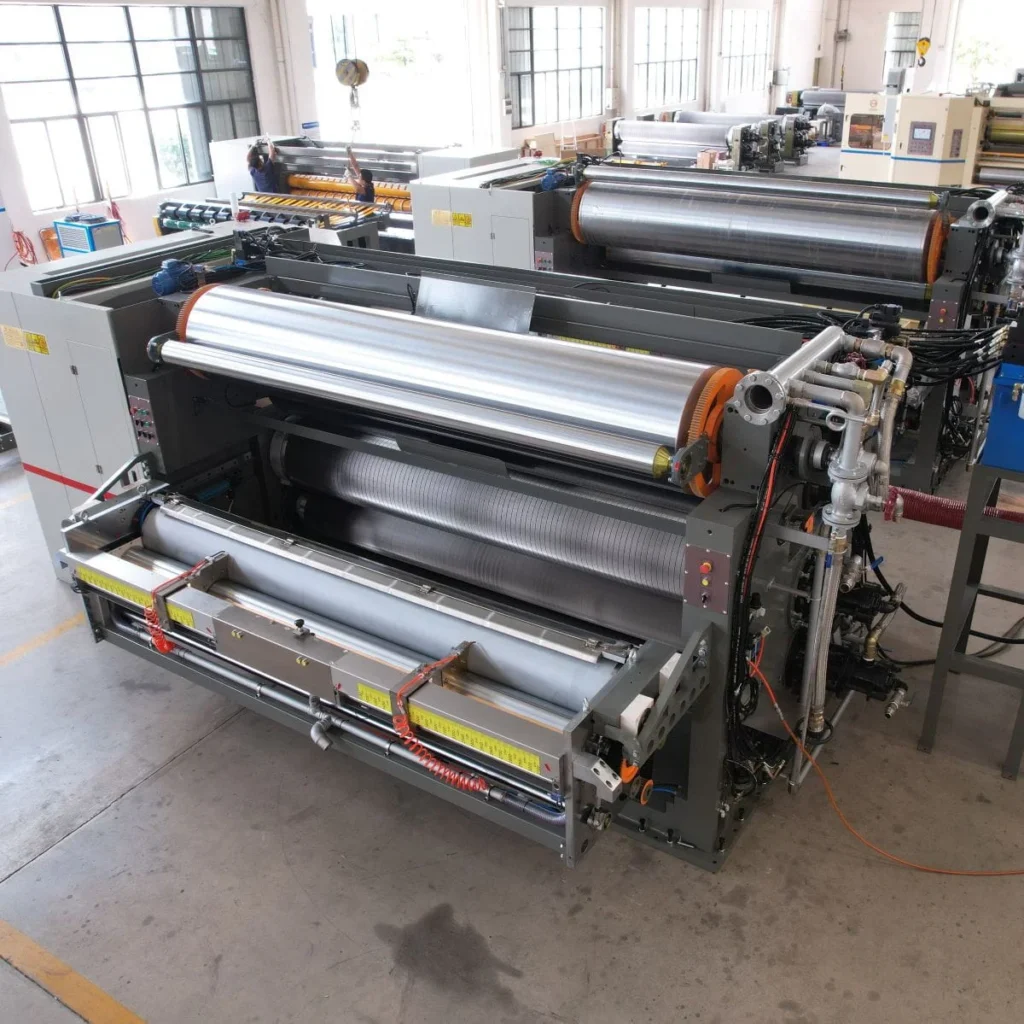
Operator Ergonomics & Safety

– Accessibility, guarding, and automation
Maintenance & Care

To ensure consistent quality and long life:
  • Daily Cleaning – Remove starch build‑up from rolls and glue unit.
  • Roll Surface Care – Avoid scratches; inspect flute profile regularly.
  • Bearing & Gear Lubrication – Follow OEM schedules.
  • Steam System Checks – Maintain correct pressure and dryness.
  • Glue Gap Calibration – Ensure even adhesive application.
  • Alignment & Tension Control – Prevent warp and mis‑tracking.
  • Scheduled Overhauls – Replace worn rolls, bearings, and seals as per OEM intervals.

Key Parameters to Order

Parameter Why It Matters Typical Range / Note
Machine Width Must match corrugator e.g., 1800–2500 mm
Flute Profile(s) Determines board caliper & strength A, B, C, E, F, etc.
Corrugating Roll Diameter Affects flute formation & speed 280–380 mm typical
Heating Source & Capacity Ensures proper flute forming Steam at 170–200 °C
Max Speed Matches line capacity 150–350 m/min
Transfer Type Influences flute quality Finger or vacuum
Glue Unit Type Adhesive control Single or dual doctor roll
Cassette Change Time Impacts downtime <15 min for modern units
Drive Type Precision & maintenance Gear or belt drive
Paper Range Flexibility e.g., 90–440 gsm

Latest Technology Trends

  • Cassette‑Type Quick Change – Flute roll swaps in 3–15 minutes.
  • RFID‑Enabled Roll Modules – Store flute‑specific settings for automatic parameter adjustment.
  • SoftTouch Glue Application – Constant contact pressure for uniform adhesive film.
  • High‑Speed Capability – Up to 480–500 m/min with precise temperature and tension control.
  • Vacuum Transfer Systems – Reduce flute deformation, improve print surface.
  • Servo‑Driven Adjustments – Automated pressure, gap, and alignment control.
  • Energy Efficiency – Optimized steam usage, heat recovery, and insulated covers.
  • Integrated Quality Monitoring – Sensors for flute geometry, bond strength, and warp control.
  • Modular Design – Easy upgrades and maintenance without full machine replacement.

Let’s build your next success  Contact Us  today.