
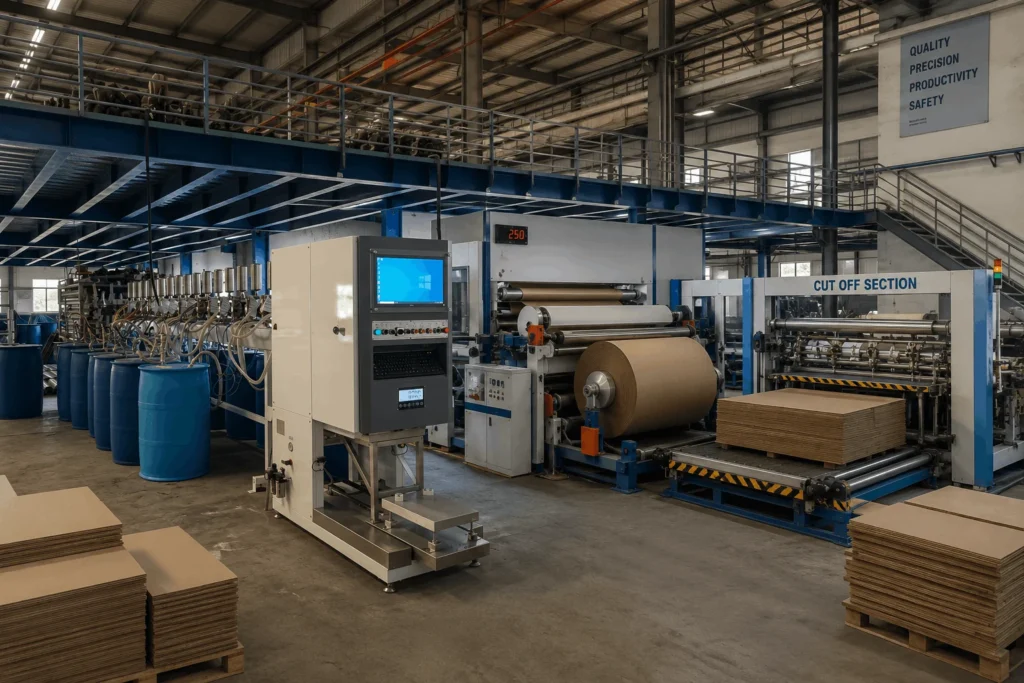
In the corrugated and converting industry, the ink kitchen (or ink system) is the centralized facility and equipment setup used to store, prepare, mix, condition, and supply printing inks to the printing machines— whether it’s a flexo printer, rotary die‑cutter, or digital press.
Its role is to:
- Ensure consistent ink color, viscosity, and temperature.
- Supply ink to the printing machine in the right quantity and quality.
- Enable efficient color matching and quick changeovers.
Reduce waste and improve print quality
Common Types
Manual Ink Kitchens
Basic mixing and storage; relies on operator skill
Semi Automatic Systems
Automated dispensing of base colors with manual adjustments.
Fully Automatic Ink Management Systems
Computer controlled mixing, dispensing, viscosity, and temperature control.
Centralized Ink Supply Systems
Serve multiple presses from one location.
Press Side Ink Systems
Smaller, dedicated units for each press
Digital Ink Supply Systems
For inkjet presses; include degassing, filtration, and precise temperature control.
Construction Features
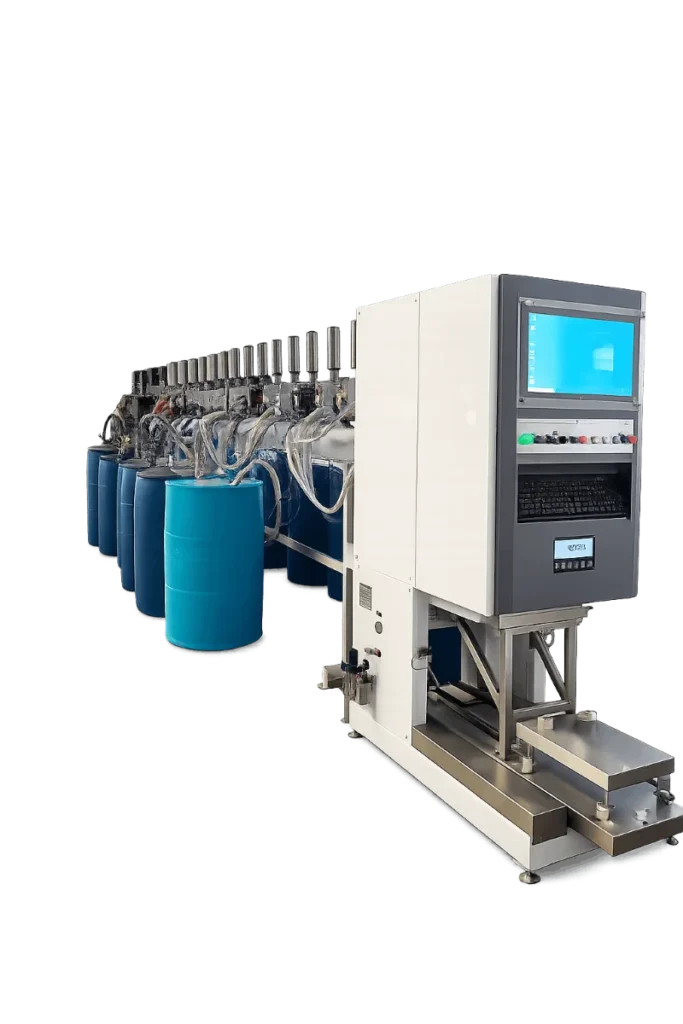
A modern ink kitchen or ink system typically includes:- Ink Storage Tanks / Drums – For bulk storage of base colors and return inks.
- Mixing & Dispensing Units – Automated or manual systems for blending colors to match recipes.
- Viscosity Control Units – Maintain ink flow properties during production.
- Pumps & Piping – Circulate ink between storage, mixing, and press fountains.
- Filters & Strainers – Remove debris to prevent print defects.
- Temperature Control – Chillers or heaters to keep ink within optimal range.
- Return Ink Handling – Systems to reclaim and recondition unused press ink.
- Color Measurement Tools – Spectrophotometers or densitometers for precise matching.
- Control Panel / Software – Recipe management, batch tracking, and integration with plant ERP.
- Wash‑Up Systems – Automated cleaning of ink lines and pumps between jobs.
Key Selection Factors
When specifying or upgrading an ink kitchen/system:- Printing Process – Flexo, litho‑lam, or digital each have different ink handling needs.
- Ink Type – Water‑based, solvent‑based, UV, or hybrid inks.
- Production Volume – High‑volume plants benefit from full automation.
- Color Range & Changeover Frequency – More SKUs require faster, more accurate mixing.
- Integration – Compatibility with ERP, color management, and press controls.
- Return Ink Management – Ability to reuse and track reclaimed ink.
- Environmental & Safety Compliance – VOC control, spill containment, ATEX compliance if needed.
- Operator Skill Level – Automation can reduce dependency on highly skilled manual mixers.
- Budget & ROI – Balance between automation cost and savings from reduced waste and downtime.
Key Selection Factors
When specifying or upgrading an ink kitchen/system:- Printing Process – Flexo, litho‑lam, or digital each have different ink handling needs.
- Ink Type – Water‑based, solvent‑based, UV, or hybrid inks.
- Production Volume – High‑volume plants benefit from full automation.
- Color Range & Changeover Frequency – More SKUs require faster, more accurate mixing.
- Integration – Compatibility with ERP, color management, and press controls.
- Return Ink Management – Ability to reuse and track reclaimed ink.
- Environmental & Safety Compliance – VOC control, spill containment, ATEX compliance if needed.
- Operator Skill Level – Automation can reduce dependency on highly skilled manual mixers.
- Budget & ROI – Balance between automation cost and savings from reduced waste and downtime.
Maintenance & Care
- Daily Cleaning – Flush lines, pumps, and filters to prevent buildup.
- Viscosity & pH Checks – Maintain ink properties during runs.
- Filter Replacement – Regularly change filters to avoid contamination.
- Pump & Seal Inspection – Prevent leaks and maintain consistent flow.
- Calibration – Keep dispensing and measuring equipment accurate.
- Tank & Pipe Cleaning – Scheduled deep cleaning to prevent sediment and bacterial growth (especially in water‑based inks).
- Software Updates – Keep control systems current for accuracy and security.
- Safety Checks – Inspect spill containment, ventilation, and PPE compliance.
Latest Technology Trends
- Fully Automated Ink Kitchens – Recipe‑driven, closed‑loop systems with minimal operator intervention.
- Inline Viscosity & pH Sensors – Real‑time adjustments without manual checks.
- Return Ink Re‑Blending – Automated systems that recondition and reincorporate unused ink into new batches.
- IoT & Cloud Connectivity – Remote monitoring, predictive maintenance, and usage analytics.
- Energy‑Efficient Pumps & Drives – Lower operating costs and environmental impact.
- Digital Color Management Integration – Direct link between prepress color data and ink dispensing.
- Barcode/RFID Tracking – For batch traceability and inventory control.
- Eco‑Friendly Inks & Systems – Designed for bio‑based inks and reduced VOC emissions.
- Press‑Side Mini Kitchens – Decentralized units for quick small‑batch mixing near the press.
Key Parameters to Order
Parameter | Why It Matters | Typical Range / Note |
System Type | Automation level | Manual, semi‑auto, full auto |
Ink Type | Determines materials & pumps | Water‑based, solvent, UV |
Capacity | Matches production volume | 200 L drums to multi‑ton tanks |
Dispensing Accuracy | Color consistency | ±1 g to ±10 g |
Viscosity Control Range | Print quality | e.g., 20–40 s Zahn cup |
Temperature Control | Ink stability | ±1 °C |
Number of Base Colors | Recipe flexibility | 8–16+ |
Return Ink Handling | Waste reduction | Yes/No, automated/manual |
Integration | Data & control | ERP, spectro, press link |
Footprint | Space planning | OEM‑specific |
Let’s build your next success Contact Us today.