

Single Facer
THE HEART OF THE CORRUGATOR LINE
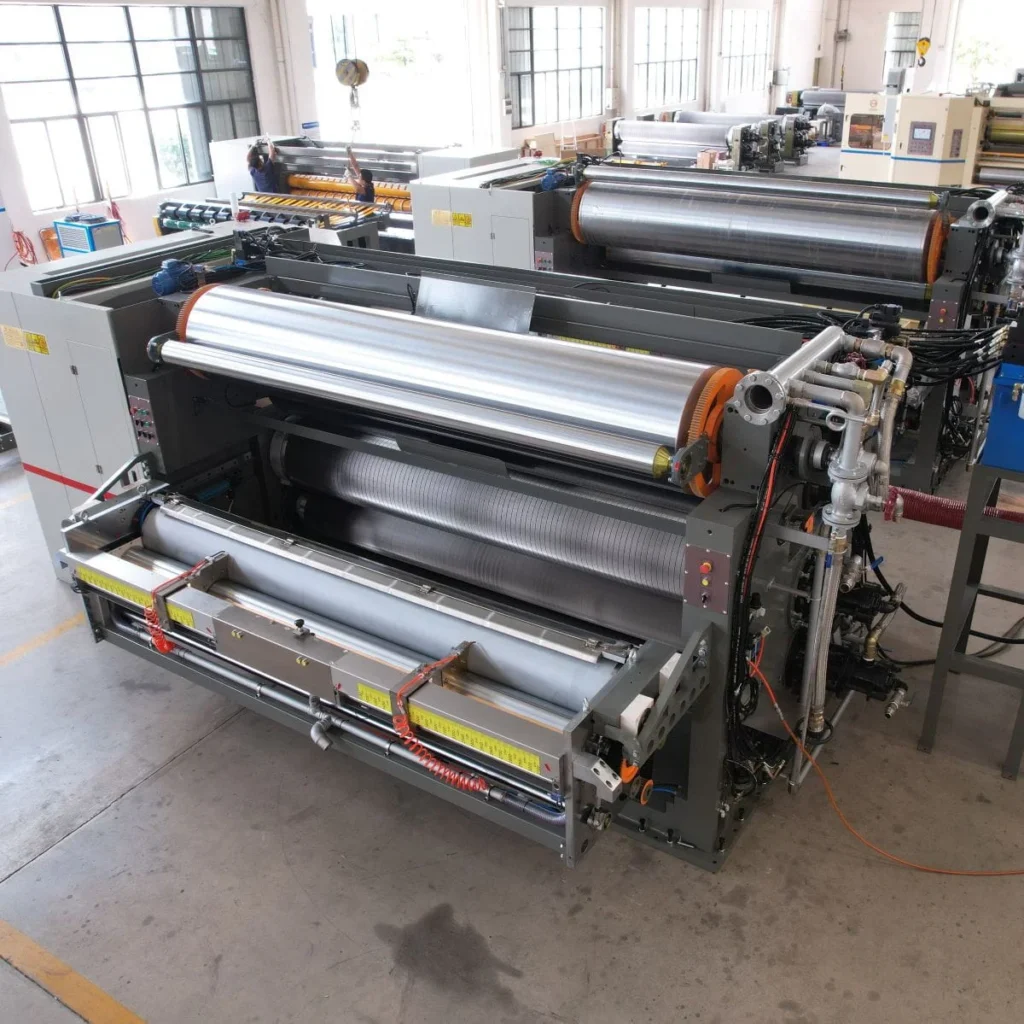
It’s the first major section where the corrugated medium (fluting) is formed and glued to a liner to produce single‑face board.
Single Facer
Construction Features

Corrugating Rolls
Precision ground, heated rolls with flute profiles.

Pressure Roll
Presses liner to fluted medium for bonding

Preheaters & Preconditioners
Control paper temperature and moisture for proper forming

Glue Unit
Applies starch based adhesive evenly to flute tips

Drive & Control System
Synchronizes roll speeds, tension, and heat

Cassette System
Allows fast flute roll swaps.

Steam System
Supplies heat to corrugating rolls for flute formation

Frame & Bearings
Heavy duty construction for stability at high speeds

Common Types
- Fixed‑Roll Single Facers – Traditional design; flute roll changes require downtime.
- Cassette‑Type Single Facers – Quick‑change flute roll cassettes; minimal downtime for flute changes.
- Fingerless Single Facers – Use vacuum transfer instead of fingers; reduce flute damage and improve printability.
- Finger‑Type Single Facers – Traditional design with fingers guiding the medium; robust and proven.
- High‑Speed Single Facers – Designed for >300 m/min with advanced controls and heat systems.
Common Types
- Fixed‑Roll Single Facers – Traditional design; flute roll changes require downtime.
- Cassette‑Type Single Facers – Quick‑change flute roll cassettes; minimal downtime for flute changes.
- Fingerless Single Facers – Use vacuum transfer instead of fingers; reduce flute damage and improve printability.
- Finger‑Type Single Facers – Traditional design with fingers guiding the medium; robust and proven.
- High‑Speed Single Facers – Designed for >300 m/min with advanced controls and heat systems.
Key Selection Factors
When specifying or upgrading a single facer:

Flute Profiles Needed
– A/B/C/E/F or combinations

Production Speed
– Match to line speed requirements

Paper Grades
– Range of liner and medium weights; recycled vs. virgin fiber

Changeover Frequency
– Cassette type for frequent flute changes.

Heating System
– Steam capacity and temperature control.
Adhesive System
– Starch type, application precision, and control.

Vacuum vs. Finger Transfer
– For quality and maintenance preferences.
Machine Width
– Must match corrugator width.

Operator Ergonomics & Safety
– Accessibility, guarding, and automation
Maintenance & Care
To ensure consistent quality and long life:- Daily Cleaning – Remove starch build‑up from rolls and glue unit.
- Roll Surface Care – Avoid scratches; inspect flute profile regularly.
- Bearing & Gear Lubrication – Follow OEM schedules.
- Steam System Checks – Maintain correct pressure and dryness.
- Glue Gap Calibration – Ensure even adhesive application.
- Alignment & Tension Control – Prevent warp and mis‑tracking.
- Scheduled Overhauls – Replace worn rolls, bearings, and seals as per OEM intervals.
Key Parameters to Order
| Parameter | Why It Matters | Typical Range / Note |
|---|---|---|
| Machine Width | Must match corrugator | e.g., 1800–2500 mm |
| Flute Profile(s) | Determines board caliper & strength | A, B, C, E, F, etc. |
| Corrugating Roll Diameter | Affects flute formation & speed | 280–380 mm typical |
| Heating Source & Capacity | Ensures proper flute forming | Steam at 170–200 °C |
| Max Speed | Matches line capacity | 150–350 m/min |
| Transfer Type | Influences flute quality | Finger or vacuum |
| Glue Unit Type | Adhesive control | Single or dual doctor roll |
| Cassette Change Time | Impacts downtime | <15 min for modern units |
| Drive Type | Precision & maintenance | Gear or belt drive |
| Paper Range | Flexibility | e.g., 90–440 gsm |
Latest Technology Trends
- Cassette‑Type Quick Change – Flute roll swaps in 3–15 minutes.
- RFID‑Enabled Roll Modules – Store flute‑specific settings for automatic parameter adjustment.
- SoftTouch Glue Application – Constant contact pressure for uniform adhesive film.
- High‑Speed Capability – Up to 480–500 m/min with precise temperature and tension control.
- Vacuum Transfer Systems – Reduce flute deformation, improve print surface.
- Servo‑Driven Adjustments – Automated pressure, gap, and alignment control.
- Energy Efficiency – Optimized steam usage, heat recovery, and insulated covers.
- Integrated Quality Monitoring – Sensors for flute geometry, bond strength, and warp control.
- Modular Design – Easy upgrades and maintenance without full machine replacement.
Let’s build your next success Contact Us today.